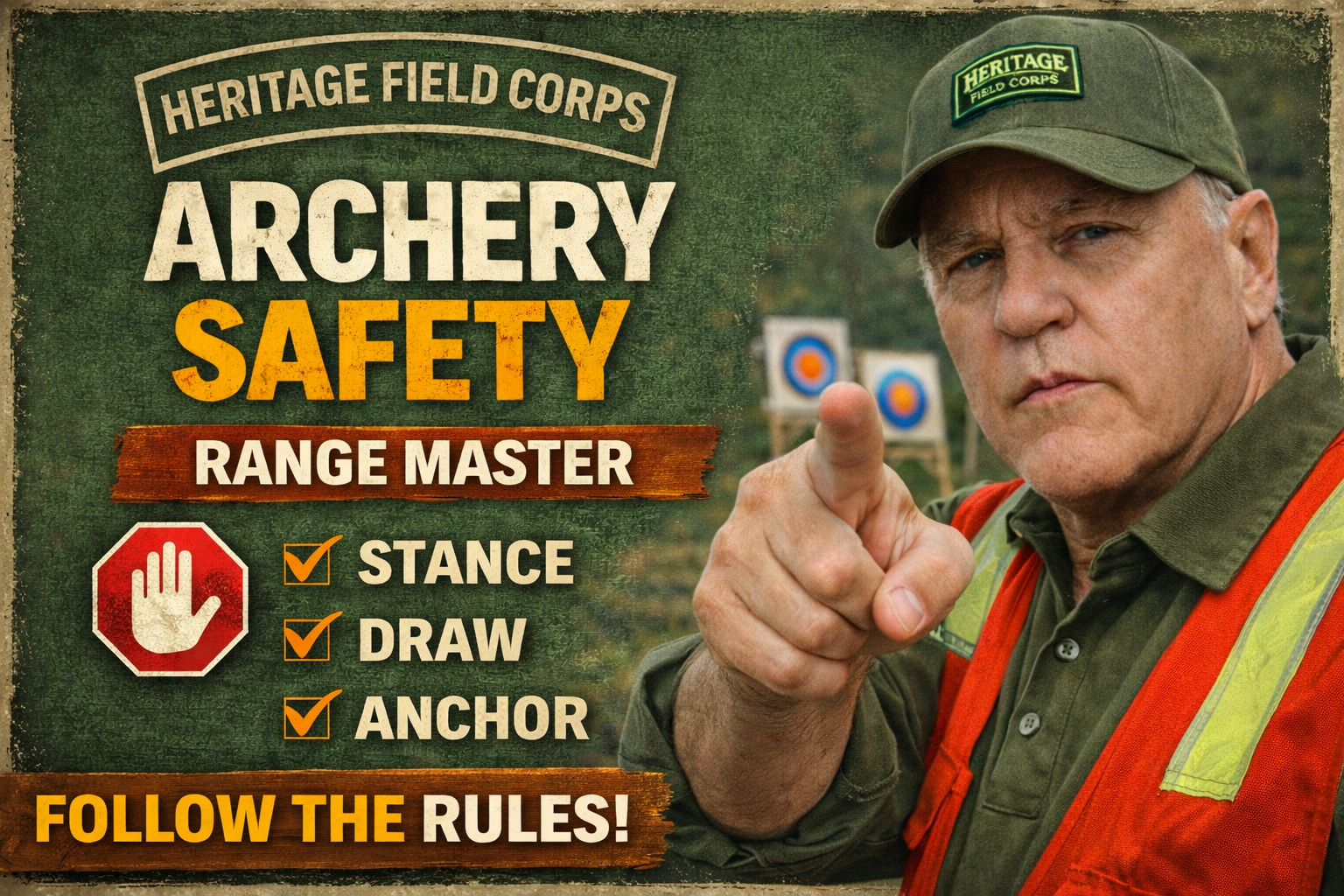
Discipline Before the Draw
Heritage Field Corps – Fieldcraft Series
Archery is one of the oldest disciplines known to man.
It teaches patience. Focus. Breath control. Restraint.
But before you ever release an arrow…
You must master something more important than accuracy.
You must master safety.
Archery safety isn’t about fear. It’s about responsibility.
It protects you, your family, your fellow archers, and anyone who steps onto the range.
At Heritage Field Corps, we believe this:
Calm is a Skill. Safety is a Discipline.
And discipline begins before you ever pick up your bow.
Safety Begins Before the First Arrow
The first responsibility of an archer is control.
Before shooting begins, these rules must be memorized and followed without exception:
The Core 10 Rules of Archery Safety
- Inspect your equipment before shooting.
- Wear proper clothing and protective gear.
- Use a bow stringer when restringing recurves, longbows, or compounds.
- Keep your arrow pointed at the ground while nocking.
- Treat every bow as if it were loaded.
- Know what is in front of and behind your target.
- Never dry fire your bow.
- Only shoot when the range is clear.
- Store bows and arrows safely.
- Never consume alcohol or mood-altering substances before or during shooting.
These aren’t suggestions.
They are habits that separate disciplined archers from reckless ones.
Additional Best Practices of a Responsible Archer
- Never draw your bow unless you intend to shoot.
- Keep arrows in a quiver or rack until ready to use.
- Always know where your arrow will land.
- Read and understand all posted range rules.
- Listen to and obey the Range Master at all times.
If you cannot follow commands, you are not ready for the range.
Establishing a Safe Shooting Area
Whether you’re at a formal range or setting up on private land, your shooting environment must be squared away.
A safe shooting area includes:
- Clearly defined boundaries
- Level shooting ground
- A safe backstop beyond targets
- A clearly marked shooting line
- Adequate spacing between archers
- A designated spectator area safely behind the line
- Posted range rules visible to all
If you wouldn’t trust your child to stand there — it isn’t safe enough.
Equipment Inspection: The Archer’s Responsibility
Your bow and arrows must be in working order every time you shoot.
Inspect Your Bow
- Check limbs for cracks or splintering
- Inspect strings for fraying or loose strands
- On compound bows, inspect pulleys and limb mounts
- Confirm stabilizers and sights are secure
Inspect Your Arrows
- Check shaft straightness
- Confirm fletching is secure
- Ensure tips are tight and undamaged
- Inspect nocks for cracks
Check Your Accessories
- Arrow rest intact and aligned
- Nock point properly aligned at full draw
- Finger tab or glove in good condition
- Mechanical release functioning properly
If you hear a cracking or popping sound during draw — lower immediately.
Step off the line.
Notify the Range Master.
Inspect before continuing.
There is no such thing as “just one more shot.”
Proper Shooting Clothing and Protective Gear
Your clothing matters.
Loose fabric and bowstrings do not mix.
Before stepping to the line:
- Avoid loose sleeves
- Wear an arm guard
- Consider a chest guard if needed
- Use a finger tab, glove, or mechanical release
- Wear closed-toe shoes with good traction
- Tie back long hair
- Remove loose jewelry
Small oversights cause preventable injuries.
Understanding Range Master Commands
A disciplined range runs on clear commands.
Know them. Obey them.
“Archers on the line”
Step forward with bow in hand.
“Begin shooting”
Nock, draw, aim, release.
“Cease fire”
Immediately stop. Lower bow. Secure arrows.
“Retrieve arrows”
Walk forward only after this command.
If you ever hear “Cease fire,” you stop immediately — no questions.
Arrow Retrieval: Controlled and Calm
Injuries often happen during retrieval — not shooting.
Follow these guidelines:
- Wait for command.
- Walk — never run.
- Pull one arrow at a time.
- Pull straight back — do not bend the shaft.
- Collect arrows beyond the target carefully.
- Return behind the shooting line before relaxing.
Discipline doesn’t end when the arrow leaves the bow.
Shooting Alone: Extra Responsibility
There’s something peaceful about shooting alone.
But solitude increases risk.
If you practice solo:
- Tell someone where you’re going and when you’ll return.
- Inspect gear the night before.
- Walk the full shooting area before setup.
- Ensure arrows are retrievable and safe.
- Carry a charged phone.
- Never shoot at unsafe targets like trees.
- Stop immediately if equipment feels off.
Confidence is good. Complacency is dangerous.
Equipment Failure & Safe Recovery
If something feels wrong — it probably is.
If you hear:
- Cracking
- Popping
- Sudden string vibration change
Lower the bow immediately.
Step off the line.
Inspect thoroughly.
Clear the issue before returning.
An equipment failure at full draw can cause serious injury.
Annual Safety Review
Archery safety isn’t a one-time lesson.
Each season:
- Inspect all gear thoroughly.
- Replace worn strings and components.
- Refresh your first aid kit.
- Review your safety procedures.
- Reassess your shooting area.
Preparedness is a living system.
The Archery Safety Checklist
Before every range session, confirm:
- Area clear of people and pets
- Equipment inspected
- Proper clothing and protection worn
- Range commands understood
- First aid kit nearby
- Phone accessible
- Weather conditions evaluated
- Youth supervised or solo plan in place
If one item isn’t checked — you are not ready to shoot.
Final Thoughts from OG Ranger
Archery is not just about hitting a target.
It’s about control.
Control of your body.
Control of your equipment.
Control of your environment.
Safety must be integrated into your shooting form — just like your anchor point and breathing.
Because a disciplined archer doesn’t just aim well.
He protects those around him.
And that’s what Heritage Field Corps is about:
Passing down skill with responsibility.
Stand steady.
Shoot straight.
And lead by example.
— OG Ranger
Leave a Reply