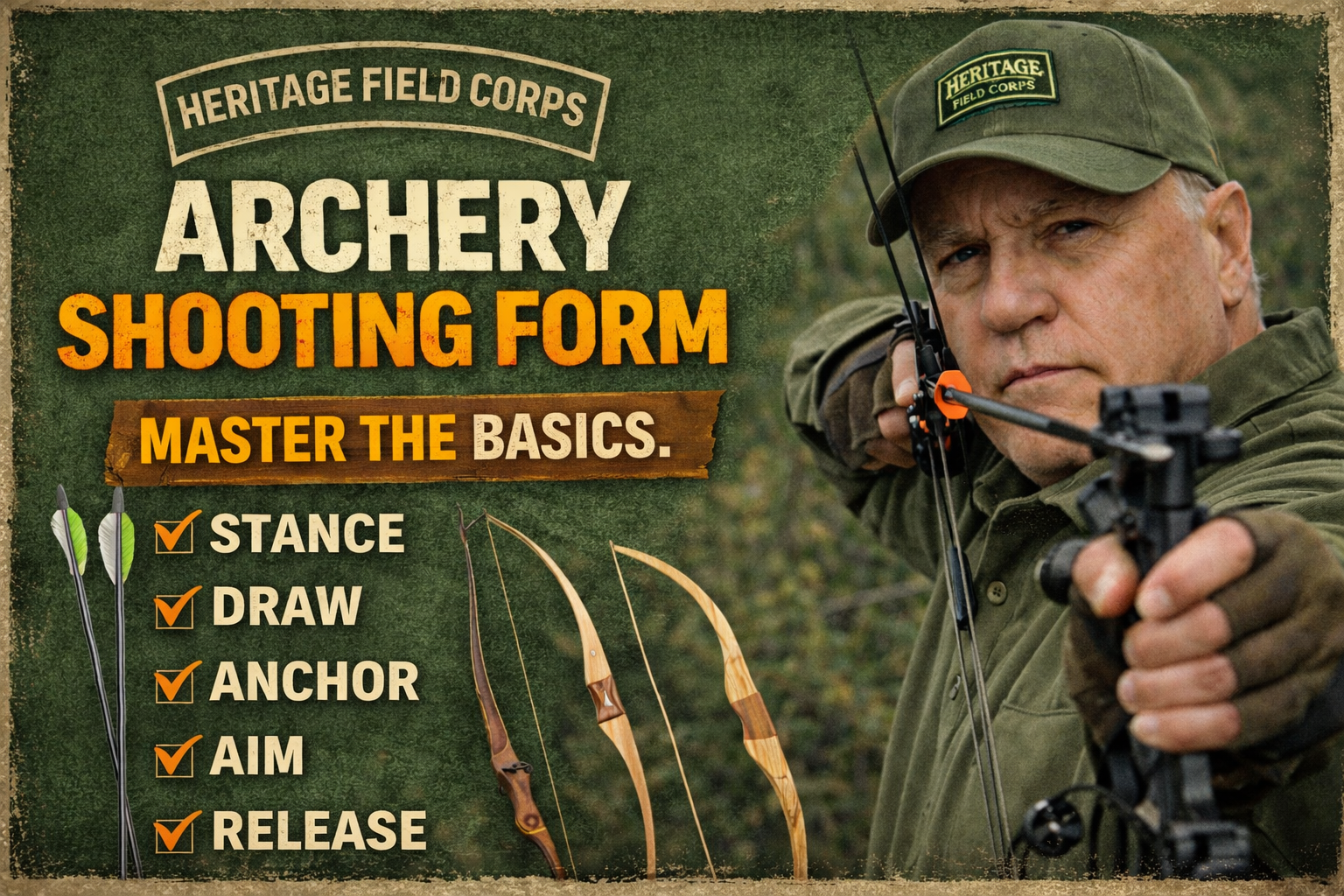
Precision Through Discipline
Heritage Field Corps – Fieldcraft Series
Everyone talks about accuracy.
But accuracy is the result — not the goal.
The goal is form.
Good shooting form allows you to:
- Shoot accurately
- Shoot safely
- Shoot consistently
- Shoot for decades without injury
If you want to truly enjoy archery — not just try it — you must build proper form from day one.
At Heritage Field Corps, we don’t rush skill.
We build it.
Why Shooting Form Matters
Form is what preserves your strength.
Repetition builds:
- Upper back strength
- Shoulder stability
- Controlled breathing
- Energy efficiency
Drawing properly uses your back muscles — not your arms.
Holding properly conserves energy — so you release only when the sight picture is steady.
And perhaps most importantly:
Proper form prevents injury.
Archery is a centuries-old practice. With good form, you can enjoy it for the rest of your life.
Step-by-Step: What Good Form Looks Like
Let’s break it down.
1. Stance – Your Foundation
Everything begins at your feet.
- Stand shoulder-width apart
- Feet parallel to the shooting line
- Weight evenly distributed
- Knees slightly relaxed
Your stance must be stable and repeatable.
If your stance shifts — your arrow will shift.
Variations:
- Open stance – front foot slightly behind rear, hips open to target
- Closed stance – front foot slightly ahead, hips closed
Choose what feels stable and repeatable.
Stability is strength.
2. Handedness & Eye Dominance
Before anything else, determine:
- Dominant hand
- Dominant eye
Your dominant eye plays a critical role in aiming.
If you are cross-dominant (right-handed, left-eye dominant), you may need to train deliberately or choose equipment accordingly.
Don’t guess. Test it.
The bow must match the archer.
3. Posture – Align the Frame
- Back straight
- Shoulders relaxed
- Hips parallel to the arrow at full draw
- Head upright, not tilted
Good posture reduces joint strain and improves repeatability.
Your body should look balanced — not twisted.
4. Grip – Firm, Not Tight
This is where many beginners struggle.
Do not “grab” the bow.
The bow sits in the thenar space — the thick pad between your thumb and index finger.
- Angle hand approximately 45 degrees
- Fingers relaxed
- Wrist loose
- Pressure applied through the base of the thumb
A tight grip causes torque.
Torque causes missed shots.
Relaxed control produces consistency.
5. Nocking the Arrow – Calm and Controlled
Before nocking:
- Point bow at the ground
- Stay behind the shooting line
Set the arrow on the rest.
Ensure the index feather (odd-colored vane) faces outward.
Snap the nock onto the string at the nocking point until you feel it click.
Consistency here builds consistency downrange.
6. Drawing – Use Your Back, Not Your Arms
Raise the bow toward the target first.
Then draw.
Inhale as you begin the draw.
Pull using your back muscles — not your biceps.
Your drawing elbow should be slightly higher than the arrow.
At the same time:
Push the bow forward with your bow arm.
This balanced push-pull motion creates smooth power.
7. Finger Position (Tab Hand)
For beginners, the most common and safe method is:
Three Under – index, middle, and ring fingers below the arrow.
Other styles:
- 1 Over / 2 Under (common in Olympic shooting)
- Advanced variations after mastery
Hook the string at the first joint (DIP joint).
Do not curl fingers deeply around the string.
Precision comes from simplicity.
8. Anchor Point – Your Reference Mark
An anchor point is where your drawing hand settles every time.
Without a consistent anchor — there is no consistent shot.
Common anchor options:
- Index finger at corner of mouth (side anchor)
- String touching nose and chin (low anchor)
- Mechanical release anchored to cheek or ear lobe
Choose one.
Repeat it every time.
Consistency builds accuracy.
9. Aiming – Calm the Mind
If you can see the target, you can hit the target.
Use your dominant eye.
Keep your body relaxed.
Exhale slowly as you settle your sight picture.
For beginners, sights are fine.
Instinctive shooting comes later.
Do not overthink the aim.
Trust your form.
10. Release – Clean and Controlled
The release is not a jerk.
It is a relaxation.
For finger shooters:
- Exhale slowly
- Allow fingers to move straight back
- Avoid plucking
For mechanical release:
- Exhale
- Squeeze smoothly
- Do not punch the trigger
The arrow should surprise you when it leaves.
11. Follow Through – Finish the Shot
Most beginners forget this.
After release:
- Drawing hand moves slightly back toward the ear
- Shoulders remain level
- Bow arm remains extended
- Maintain posture until arrow hits the target
Do not collapse.
Carry the shot through.
This takes less than a second — but it matters.
Don’t Overhold
Holding too long:
- Fatigues muscles
- Weakens accuracy
- Strains the bowstring
Draw, anchor, aim, release.
Stay decisive.
Join a Club – Accelerate Your Growth
Archery is better in community.
A club provides:
- Instruction
- Structured practice
- Competitive challenge
- Mentorship
When joining:
- Attend orientation
- Follow all rules
- Respect range officers
- Take lessons from certified instructors
- Help newcomers learn safety
Skill grows faster when shared.
Archery and Physical Fitness
Archery is more physical than most realize.
Trail walks, target competitions, repeated draws — all build:
- Upper back strength
- Core stability
- Reflexes
- Cognitive motor skills
It’s a discipline of both body and mind.
And for young people especially — it builds maturity, focus, and confidence.
Final Thoughts from OG Ranger
Archery is beautiful because it demands discipline.
It forces you to slow down.
To breathe.
To focus.
To control your body under tension.
Master the stance.
Refine the grip.
Commit to the anchor.
Finish every shot.
And over time — your arrows will begin to reflect your discipline.
Stay steady.
— OG Ranger
Heritage Field Corps
Leave a Reply