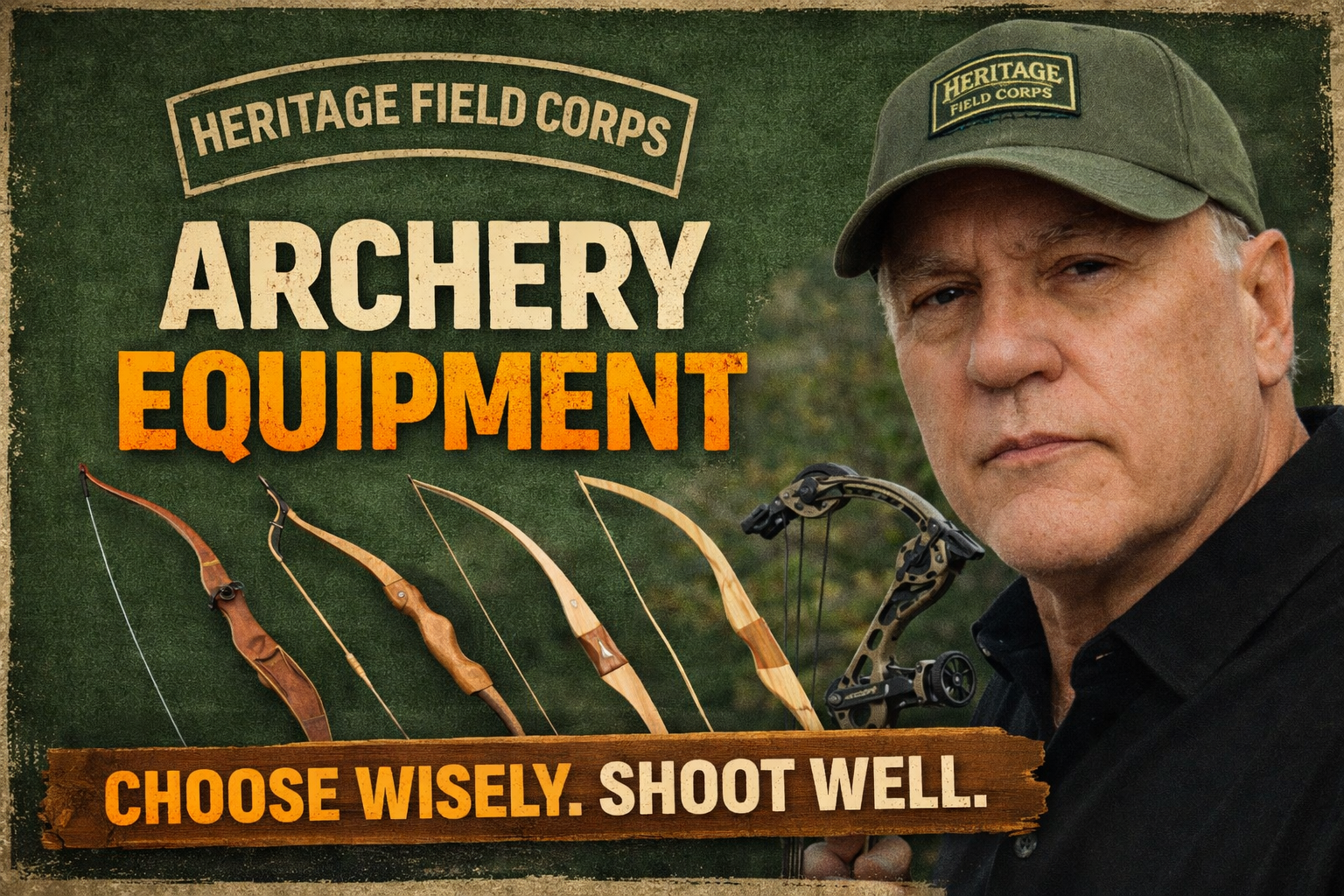
Choose with Purpose. Shoot with Confidence.
Heritage Field Corps – Fieldcraft Series
Archery is not just about releasing an arrow.
It’s about releasing it well.
And accurate shooting doesn’t start at full draw.
It starts with selecting the right equipment.
At Heritage Field Corps, we believe tools should match the man — not the other way around.
The right bow, properly fitted to your body and your purpose, will elevate your shooting experience from frustration… to freedom.
Let’s walk through it the right way.
Why Proper Bow Selection Matters
A bow should complement your form — not fight it.
When properly selected and fitted:
- Drawing feels controlled, not strained.
- Anchoring feels natural.
- Holding at full draw feels stable.
- Shooting becomes enjoyable instead of exhausting.
It’s not just about what looks good on the rack.
It’s about:
- Draw weight appropriate to your strength
- Bow length matched to your frame
- Performance capability suited to your purpose
- Craftsmanship you’re proud to own
Every bow must be configured to your current physical ability. And that ability will change over time as you improve your technique and build strength.
Choose wisely now — grow into mastery later.
Key Considerations Before You Buy
1. Skill Level
Be honest about where you are.
Beginners often do well with recurve bows.
They are straightforward, teach solid fundamentals, and typically require less complexity to operate.
Experienced archers may prefer compound bows.
The eccentric pulley system allows you to draw heavier weight while reducing hold weight at full draw — improving stability and precision.
Skill determines complexity.
2. Draw Weight
Draw weight is the amount of force required to pull the string to full draw.
Too heavy — you’ll develop poor form and risk injury.
Too light — you’ll outgrow it quickly.
Most beginners should start lower and build strength gradually.
There is no honor in struggling with a bow that overpowers you.
Strength follows discipline.
3. Fit
Fit is everything.
How the bow feels in your hand…
How it settles at anchor…
How natural your grip feels…
Your grip should be relaxed.
Your draw should feel controlled.
Your anchor point should repeat consistently.
If it feels awkward — it’s wrong for you.
Work with a knowledgeable archery shop. Try multiple bows. Feel the difference.
4. Budget
Archery equipment ranges widely in cost.
A solid bow setup can range from $400 to $4,000 once you include:
- Arrows
- Sights
- Rest
- Release
- Quiver
- Case
- Targets
Buy quality within your budget.
Don’t chase hype. Chase performance.
Understanding Bow Types
Let’s break down the primary bow categories.
Recurve Bows
Description:
Limb tips curve away from the archer when unstrung. This design stores more energy and increases arrow speed.
Best For:
- Beginners
- Traditional archers
- Target shooting
- Small game hunting
Recurves teach discipline.
They reward clean form.
Longbows
Description:
Traditional straight-limbed bows made from a single stave or laminated woods. They require more strength and refined technique.
Best For:
- Traditional competition
- Archers seeking heritage shooting experience
Longbows are pure.
They demand respect and proper form.
Compound Bows (and Crossbows)
Description:
Mechanical bow systems using eccentric pulleys and cables to reduce holding weight at full draw.
Best For:
- Target competition
- Hunting
- High precision shooting
Compound bows offer:
- Adjustable draw weight
- Mechanical tuning
- High power and accuracy
They are more complex — and often more expensive — but extremely effective.
Primitive Bows
Primitive bows represent the roots of archery.
Typically handmade from woods such as:
- Osage Orange
- Hickory
- Maple
- Pacific Yew
- Red Oak
- Dogwood
These bows follow the designs used for centuries.
They are often crafted by hand using traditional tools and techniques.
Primitive archery competitions emphasize heritage skills — not mechanical advantage.
They are works of art.
But beauty must still meet performance. Buy from reputable craftsmen.
Bow Materials
Modern and traditional bows use different materials:
- Natural Wood – classic feel, heritage look
- Laminates – layered woods for improved durability
- Fiberglass – strength and consistency
- Mechanical Components – compounds with cables and pulleys
Material influences performance, durability, and feel.
How to Choose the Right Bow for You
Ask yourself these questions:
- Will I shoot occasionally for personal enjoyment?
- Will I train regularly for target shooting or competition?
- Will I hunt or shoot long distance?
- Am I drawn to primitive archery?
Let’s break that down.
If You’re Shooting for Enjoyment
A recurve is an excellent choice.
Traditional woods or laminates provide simplicity and satisfaction without overcomplication.
If You’re Training Regularly or Competing
You’ll need refinement.
Both recurve and compound bows are viable — but competition class matters.
Work with a professional shop to test multiple bows until you find:
- Proper fit
- Comfort at draw
- Reliable performance
- Appearance you appreciate
If You’re Hunting
You’ll likely consider:
- A hunting-weight recurve
- A compound bow
- A crossbow
A heavy recurve demands strength and discipline.
A compound allows mechanical tuning for power, comfort, and environmental conditions.
Choose based on your physical ability and hunting context.
If You’re Drawn to Primitive Bows
Understand this:
Handcrafted primitive bows are often expensive.
They are art.
They are heritage.
They require skill to shoot well.
Buy from a reputable craftsman.
A beautiful bow that doesn’t shoot straight is just decoration.
My Personal Perspective
I own and shoot all four types.
I’ve handcrafted many recurves, primitive bows, and arrows with my own hands.
There’s something special about shaping wood into a tool that launches an arrow true.
I love primitive bows.
I love a well-built recurve.
And I appreciate the precision engineering of a Mathews compound.
Each has its place.
Each has its discipline.
Each will teach you something different about yourself.
Final Thoughts from OG Ranger
No matter what bow you choose — you won’t regret owning one.
Archery keeps you fit.
It sharpens your focus.
It builds patience and control.
Choose wisely.
Train consistently.
Respect the craft.
And remember —
The bow doesn’t make the archer.
The archer makes the bow perform.
Stand steady.
— OG Ranger
Heritage Field Corps
Leave a Reply