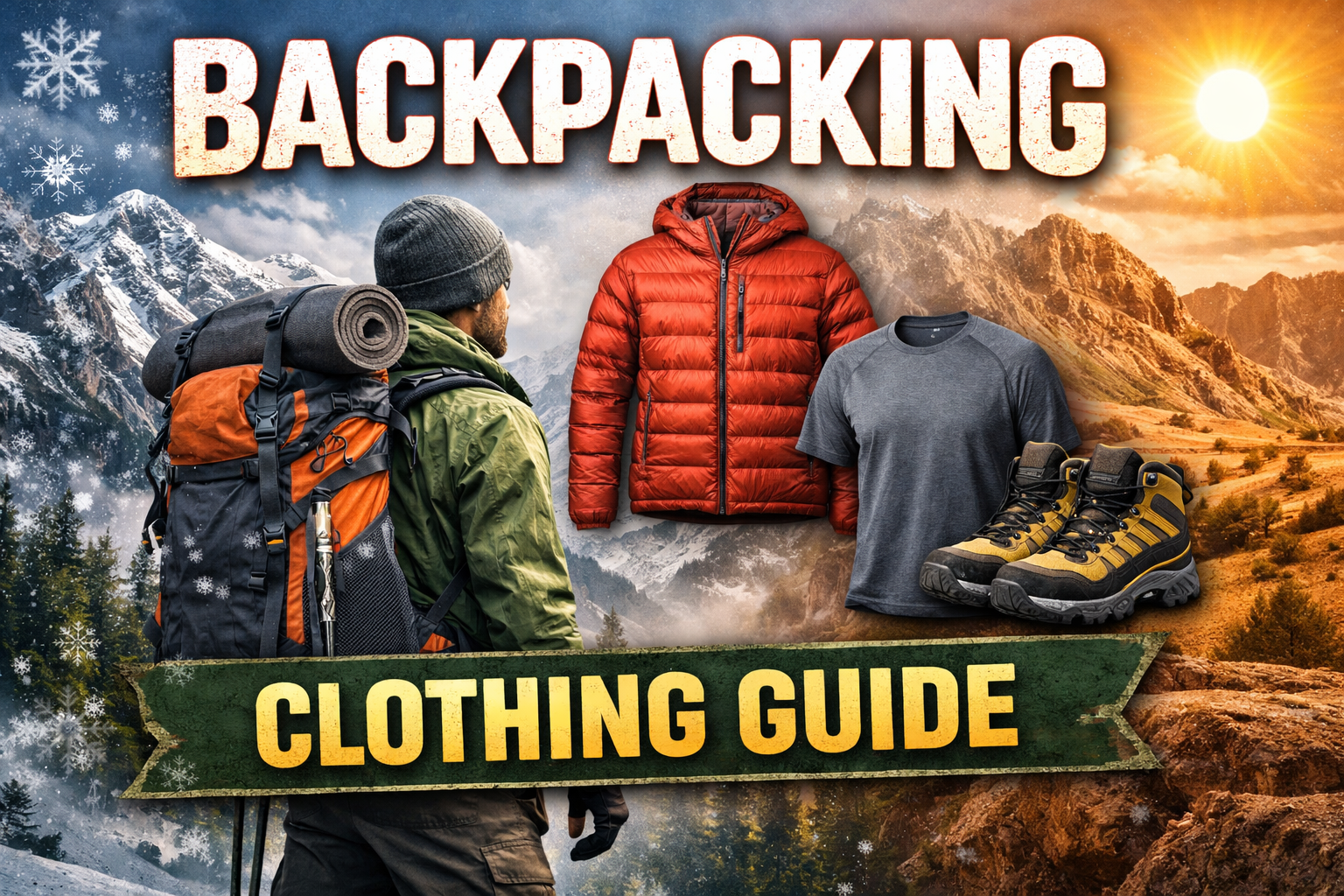
What you wear in the backcountry is more than a comfort decision — it’s a safety decision.
The right backpacking clothing protects you from the elements, regulates your body temperature, and keeps you moving efficiently. The wrong clothing can leave you cold, wet, overheated, or injured.
Let’s start with one guiding principle:
Backpacking clothing should prioritize performance over fashion.
Looking sharp on the trail is fine — but protection, durability, and adaptability come first.
Start with the Environment
Before choosing your gear, consider:
- Climate (hot, cold, wet, arid, alpine)
- Terrain (desert, forest, mountains, snow)
- Trip duration
- Expected weather changes
An alpine trek demands insulation and weather protection.
A summer hike in Arizona demands breathability and sun protection.
Prepare for the conditions you expect — and for the ones you don’t.
Weather changes quickly. Your clothing system must adapt just as fast.
Why Everyday Clothing Falls Short
Most everyday clothing is not designed for outdoor performance.
The biggest offender? Cotton.
Cotton:
- Retains moisture
- Dries slowly
- Loses insulation when wet
- Increases risk of chafing
- In cold conditions, increases hypothermia risk
Backpacking clothing should be:
- Lightweight
- Moisture-wicking
- Quick-drying
- Breathable
- Durable
- Layer-friendly
Synthetic fabrics (like polyester blends), wool, and certain technical materials are designed to pull moisture away from the body and allow it to evaporate quickly.
That moisture management matters in both summer and winter.
- In heat: it keeps you cooler.
- In cold: it prevents dangerous moisture buildup against your skin.
The Layering Principle: Your Personal Climate System
The key to smart backpacking clothing is layering.
Layering allows you to:
- Add warmth
- Remove insulation
- Adjust for activity level
- Adapt to changing weather
Instead of one heavy garment, you build a system.
With the right layers, you create what many call a “personal climate” — an adjustable system that keeps you dry, warm, and protected.
A good layering system includes five functional layers:
- Base Layer
- Inner Layer
- Mid Layer
- Insulating Layer
- Outer Layer
Let’s break them down.
1. The Base Layer (Underwear & Socks)
Your base layer sits directly against your skin. Its job is simple:
Keep you dry.
Underwear
Yes — backpacking underwear matters.
Avoid cotton. It traps moisture and causes irritation and chafing (especially on long-mile days).
Choose:
- Synthetic materials
- Wool blends
- Quick-drying athletic fabrics
For colder climates, thermal or long underwear can provide additional warmth.
For women, a moisture-wicking sports bra is often more comfortable under a loaded pack than a clasped bra.
Socks
Socks are critical. Poor sock choices lead to blisters and misery.
Options include:
- Liners – Thin socks that wick moisture and reduce friction.
- Lightweight socks – Best for warm weather.
- Midweight socks – More cushion and insulation for cooler temps.
- Mountaineering socks – Maximum warmth for extreme cold.
Best materials:
- Wool or wool blends (retain warmth when wet)
- Synthetic blends (durable and moisture-wicking)
Avoid 100% cotton socks.
Pro tip: Always carry a dry pair. Wet feet lead to blisters.
2. The Inner Layer
This is typically a moisture-wicking shirt — short or long sleeve depending on conditions.
Its job:
- Manage moisture
- Provide minimal protection
- Serve as your primary comfort layer
In hot climates, this may be all you wear for much of the day.
3. The Mid Layer
This layer provides light protection from:
- Sun
- Mild wind
- Insects
A lightweight long-sleeve synthetic shirt works well here. It adds versatility without bulk.
4. The Insulating Layer
This layer traps body heat.
Options include:
- Fleece
- Synthetic insulated jackets
- Wool sweaters
Fleece is popular because:
- It’s lightweight
- It insulates even when wet
- It dries quickly
You may carry multiple insulation layers depending on climate.
5. The Outer Layer (Your Insurance Policy)
Your outer layer protects against:
- Rain
- Wind
- Snow
- Cold exposure
Always bring an outer layer.
Even if the forecast looks perfect.
This layer can mean the difference between inconvenience and emergency.
There are three general categories:
Waterproof / Non-Breathable
- Keeps water out
- Traps sweat inside
- Best for minimal activity
Water-Resistant / Breathable
- Great ventilation
- Not ideal for heavy rain
- Best when overheating is a bigger concern than rainfall
Waterproof / Moderately Breathable
- The most versatile option
- Good balance of protection and airflow
- Ideal for varied conditions
A quality waterproof jacket with a hood and waterproof pants are strong choices for extended trips.
Make sure your outer layer fits comfortably over all other layers.
Footwear: Your Most Important Decision
You can endure discomfort in many places.
Your feet are not one of them.
Blisters or ankle injuries can end a trip fast.
Above-the-Ankle Boots
- Best for heavy loads
- Provide ankle support
- Better protection against mud and water
Ankle Boots
- Good for moderate loads
- Balance support and weight
Hiking Shoes
- Lightweight
- Ideal for smooth trails and light packs
- Shorter break-in time
Materials
- Full-grain leather: durable, water-resistant, heavier, longer break-in
- Synthetic: lighter, quicker break-in, less durable
Break in your boots before any long trek.
Start with short walks and increase gradually.
Don’t Forget Sandals
Lightweight sandals are excellent:
- Around camp
- For river crossings
- For giving your feet a break
Getting the Clothing Formula Right
Your clothing should balance:
- Breathability
- Moisture-wicking
- Rapid drying
- Insulation
- Durability
- Wind protection
- Waterproofing
- Freedom of movement
No single item does it all.
Layering gives you flexibility.
And flexibility equals comfort — and safety.
Climate-Specific Considerations
Hot & Arid Regions
- Lightweight, breathable fabrics
- Sun-protective long sleeves
- Wide-brim hat
- Ventilation prioritized
Cold & Snowy Conditions
- Thermal base layers
- Strong insulation
- Windproof outer shell
- Insulated headwear
Prepare for unpredictability.
A Final Word on Preparation
Your backpacking clothing is not about looking rugged.
It’s about being ready.
If you follow the layering principle and avoid moisture-retaining fabrics like cotton, you can build a clothing system that adapts to nearly any environment.
It takes practice to dial in your personal formula — every person’s insulation needs differ based on body type, conditioning, and activity level.
But when you get it right, you’ll move confidently, comfortably, and safely through whatever terrain lies ahead.
And that’s the goal.
Leave a Reply